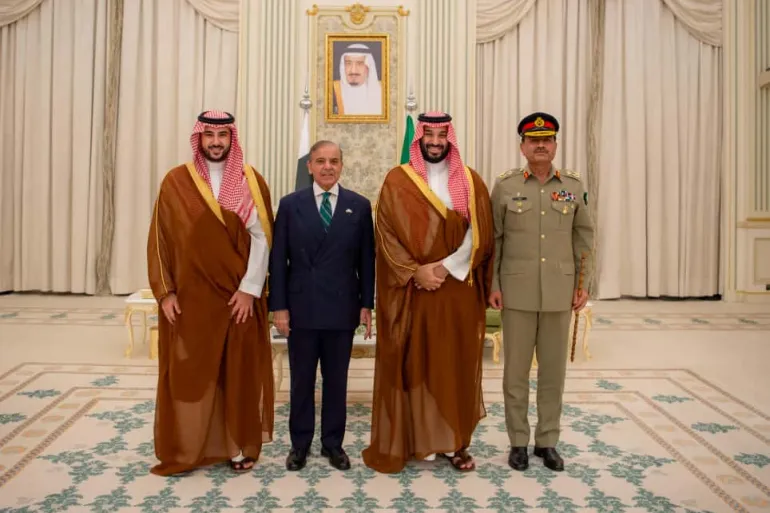
Saudi Arabia and Pakistan on September 17, 2025, sealed a landmark “Strategic Mutual Defence Agreement” in Riyadh that declares any aggression against one will be treated as an aggression against both — a compact both sides described as a major upgrade of a decades-long security partnership. The ceremony, held at Al Yamamah Palace, was attended by Saudi Crown Prince Mohammed bin Salman and Pakistan’s Prime Minister Shehbaz Sharif, and was presented by state media as a step to “strengthen joint deterrence” and deepen ties across political, military and economic fields.
The text and tone of official statements make the pact more binding than previous ad-hoc arrangements: Pakistan and Saudi officials said the agreement will develop “aspects of defence cooperation” and coordinate responses to common threats, signalling a closer operational relationship between the two militaries. Pakistan’s prime minister thanked the Saudi leadership for what Islamabad framed as fraternal support, while Saudi hosts gave Shehbaz Sharif a guard of honour and an official reception that underscored the symbolic weight of the visit.
Riyadh moved quickly to mark the occasion at home: the Kingdom’s Ministry of Manpower and Social Development announced a public holiday to observe the 95th National Day on Tuesday, 1 Rabi al-Thani 1447 AH — corresponding to September 23, 2025 — tying the diplomatic event to domestic commemoration and signalling a high level of official celebration of the new security tie. The declaration applies across government, private and non-profit institutions.
What has drawn intense international attention is the pact’s strategic implication for the region because Pakistan is the only Muslim-majority state with a declared nuclear arsenal. Analysts and some media reports suggest the agreement could function as a de-facto extension of Pakistan’s deterrent posture to Saudi territory — a development that, while not spelled out in nuclear terms in the public text, nonetheless reframes how Gulf states might think about their security guarantees. Commentators say the pact arrives amid broader Gulf anxiety about shifting U.S. commitments and recent regional escalations, and that it could alter deterrence calculations across West Asia.
Reactions have been swift and varied. Egypt publicly welcomed the agreement and lauded the strengthening of brotherly ties and regional solidarity, while other capitals have adopted a more cautious tone — New Delhi, for example, said it was analysing the implications and urged sensitivity to regional relationships. International commentators and think-tanks have called for clarity on operational details (command arrangements, force deployments and any formal nuclear assurances) to avoid misperceptions that could accelerate an arms-race dynamic. For now, officials in Islamabad and Riyadh stress the pact is defensive, framed in language of deterrence and mutual aid; the strategic ripples, however, are likely to animate diplomacy in the weeks to come.