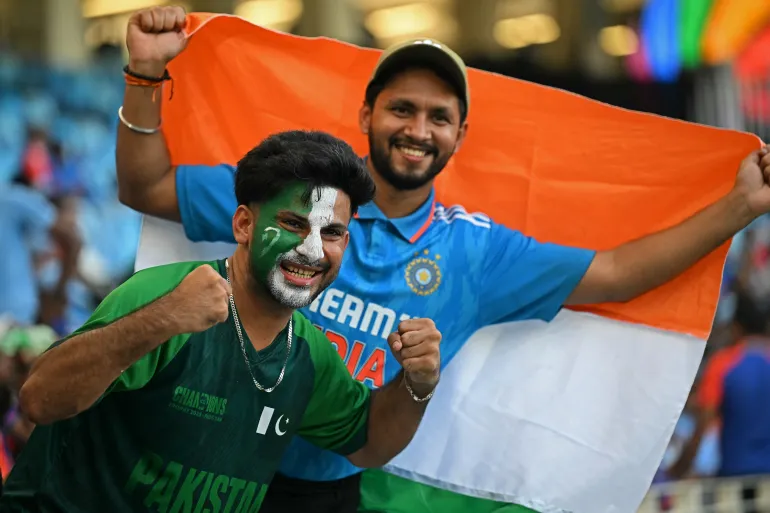
In the Asia Cup 2025, the Super Four stage begins with a heavyweight clash: Pakistan vs India. Hopes are high in Pakistan that the team can make a statement, prove their mettle, and perhaps overcome the shadow of recent controversy. India, on the other hand, looks to continue its dominance in this rivalry – both on the record books and in the psychological space.
The Controversy: When Etiquette Meets Real-World Events
In their Group A match on September 14, 2025, India defeated Pakistan by seven wickets. Pakistan were restricted to a modest 127-9, courtesy of a disciplined spin attack from India. Among the Indian batters, Abhishek Sharma and Tilak Varma scored 31 apiece; captain Suryakumar Yadav remained unbeaten on 47 to steer the chase comfortably.
What sparked further debate wasn’t just the result, but what followed. India’s players declined the customary post-match handshakes with their Pakistani counterparts. The Indian captain said they were dedicating their victory “to the armed forces and the victims of the Pahalgam terror attack” (April 22), calling some things “above sportsmanship.” Pakistan expressed disappointment; the Pakistan Cricket Board (PCB) protested, calling it unsportsmanlike, and even asked for the match referee, Andy Pycroft, to be removed.
Politics and off-field tensions are deeply intertwined with this rivalry. The Pahalgam attack, the subsequent military responses, and the larger Kashmir issue have made any India-Pakistan encounter more than just a cricket match. Many argue that sports should stay separate from political narrative; others see symbolic gestures (like the no handshake) as inevitable reactions in fraught times.
The Stakes for Pakistan: Super Four & Pride
Pakistan made it through Group A, finishing second after rebounding with a win over the UAE by 41 runs. Fakhar Zaman’s fifty and Shaheen Afridi’s explosive tail end played key roles. Still, concerns remain about consistency, particularly in the middle order.
Now comes India vs Pakistan again in the Super Four. For Pakistan, this is not just about points; it’s about respect, restoring confidence, and showing they can perform under pressure. For India, it’s about reinforcing their dominance and perhaps maintaining psychological upper hand.
Cricket Stats: History Favors India
To understand how big the challenge is, here are relevant statistics:
-
In T20 Internationals between India and Pakistan, 14 matches have been played; India have won 10, Pakistan 3, and 1 ended in a tie.
-
In the Asia Cup (all formats), the two sides have met about 20 times. India have won 11, Pakistan 6, with a few no results.
-
Specifically in Asia Cup T20 matches, India lead 3-1 over Pakistan. Pakistan’s only win came in the 2022 Super Four stage.
-
At the Dubai International Cricket Stadium (venue for the current Asia Cup 2025 matches), India have played 11 T20Is, winning 7 and losing 4. Their win/loss ratio is around 1.75 at this venue.
These numbers show that historically India have held the edge, especially in T20Is. But cricket is played on the day; records are psychological, not guarantees.
Why Politics Shouldn’t Ruin Sports
Sporting events like India vs Pakistan have long been seen to carry diplomatic undercurrents – “cricket diplomacy.” Yet, many believe that while national pride is unavoidable, gestures which inject political statements into sportsmanship rituals (handshakes, dedicating wins, etc.) risk eroding the spirit of togetherness that sport ideally promotes.
As Pakistan’s board chairman, Mohsin Naqvi, put it, the lack of handshake was “utterly disappointing … bringing politics into the game goes against the very spirit of cricket.”
Opportunity & Pressure
For Pakistan, this Super Four rematch is an opportunity: to bounce back, prove that style and decorum aside, performance matters. The pressure is high, but sometimes pressure creates moments. If Pakistan can tighten their batting order, find early breakthroughs with the ball, and possibly silence the optics of recent controversy with an emphatic performance, then they can shift narrative.
For India, the goal will be to avoid letting politics become a distraction, and fight cleanly on the field. Win with respect.